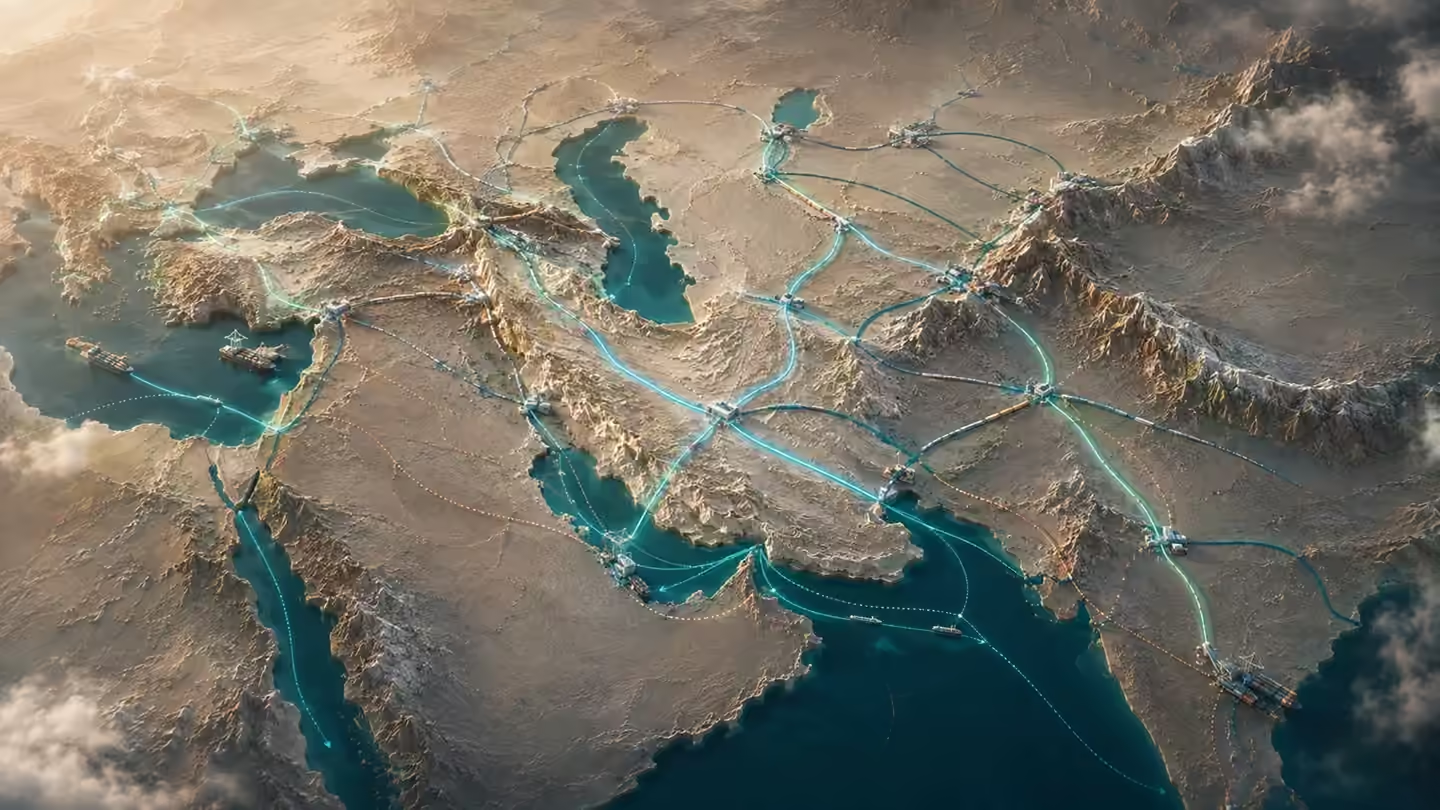
Which port, terminal or crossing is the network bottleneck? In a network viewed from Iran, bottlenecks emerge where cargo waits, transport modes change or passage becomes uncertain. A node's strategic weight should be tested against candidate alternatives using origin, destination, cargo, time, cost and reliability evidence.
Which port, terminal or crossing is the network bottleneck?
Origin consolidationLine-haul transportBorder and terminal handlingFinal distribution
Port, rail, road and warehousing in one freight chain.02
Where geography meets infrastructure
Geography becomes economically relevant when a sector meets a working corridor, node or project. Each connection carries its evidence state and source; proximity alone is not proof of demand.
Cost and time compared with a bypass route
Connection to relevant corridors, nodes and infrastructure
Corridors cut across sectors; they are not sectors themselves. A route may improve access to a market, but a mapped connection alone does not prove demand or performance.
Multimodal terminalConsolidation and distribution centerDigital transit-facilitation service
Projects in the source record
ProjectInsufficient data · The current atlas has no source-backed, contextual sector-to-project relation.Source: not recorded
05
What enables or constrains delivery?
Recorded incentives
Incentives are recorded only with an official source and validity date
Synergy with connected infrastructure and markets
Decision constraints
Cargo volume and composition addressable on the selected route
Operational capacity, dwell time and utilization of the node
Cost and time compared with a bypass route
06
Who may invest, and what can be measured?
Investor groups
Terminal operators
3PL/4PL providers
Infrastructure funds
What the indicators can support
ThroughputInsufficient data · The sector taxonomy names this indicator, but the current data has no numeric observation with unit, period, geography, and row-level source.Value / unit / period / geography / source: — / — / — / — / —
Dwell timeInsufficient data · The sector taxonomy names this indicator, but the current data has no numeric observation with unit, period, geography, and row-level source.Value / unit / period / geography / source: — / — / — / — / —
Cost per tonne-kmInsufficient data · The sector taxonomy names this indicator, but the current data has no numeric observation with unit, period, geography, and row-level source.Value / unit / period / geography / source: — / — / — / — / —
Data confidence: provisional — evidence coverage varies by corridor and project
07
What the evidence shows, and what is still missing
Iran remains the reference point. The current data records no independent impact observation at province or sector level. That is a gap in evidence, not evidence of no impact.
Provinces: 0/31 observed · Sectors: 0/15 observed
All matrix cells and evidence state
31 provinces
آذربایجان شرقی · Insufficient data
آذربایجان غربی · Insufficient data
اردبیل · Insufficient data
اصفهان · Insufficient data
البرز · Insufficient data
ایلام · Insufficient data
بوشهر · Insufficient data
تهران · Insufficient data
چهارمحال و بختیاری · Insufficient data
خراسان جنوبی · Insufficient data
خراسان رضوی · Insufficient data
خراسان شمالی · Insufficient data
خوزستان · Insufficient data
زنجان · Insufficient data
سمنان · Insufficient data
سیستان و بلوچستان · Insufficient data
فارس · Insufficient data
قزوین · Insufficient data
قم · Insufficient data
کردستان · Insufficient data
کرمان · Insufficient data
کرمانشاه · Insufficient data
کهگیلویه و بویراحمد · Insufficient data
گلستان · Insufficient data
گیلان · Insufficient data
لرستان · Insufficient data
مازندران · Insufficient data
مرکزی · Insufficient data
هرمزگان · Insufficient data
همدان · Insufficient data
یزد · Insufficient data
15 sectors
Real Estate & Construction · Insufficient data
Tourism & Quality of Life · Insufficient data
Transport & Logistics · Insufficient data
Energy · Insufficient data
Agriculture & Food Processing · Insufficient data
Financial Services · Insufficient data
Chemicals · Insufficient data
Mining & Metals · Insufficient data
Healthcare Services & Devices · Insufficient data
Advanced Manufacturing · Insufficient data
Pharma & Biotech · Insufficient data
Environmental Services · Insufficient data
Human Capital & Innovation · Insufficient data
Information & Communication Technology · Insufficient data